

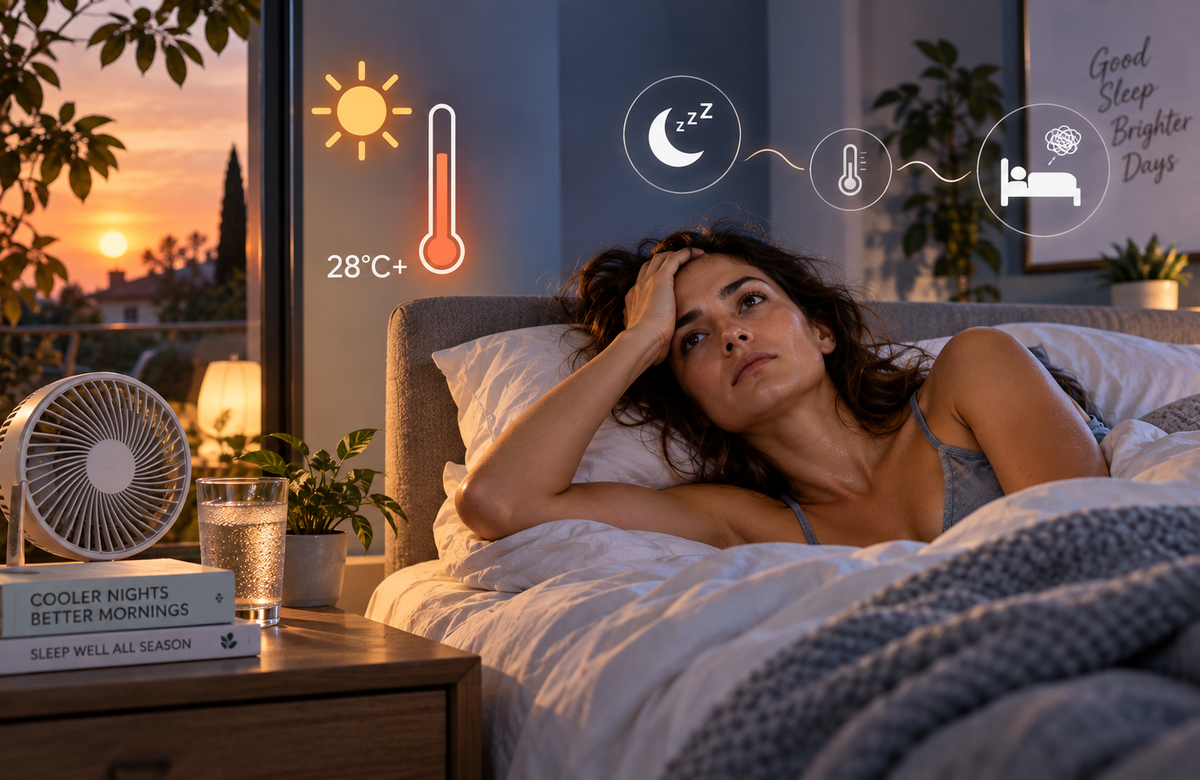
Your body already knows how to fall asleep. It has a precise mechanism, backed by millions of years of evolution: to enter the deep stages of sleep, your core temperature has to drop by 1–2°C. It's not a preference, it's biology. And when it's too hot, this mechanism gets stuck.
A study published in Frontiers in Neuroscience (Harding, Franks, Wisden, 2019) confirmed that skin cooling — through peripheral vasodilation — is the biological signal that triggers the N3 deep sleep and REM stages. [1]
What happens when we sleep in the heat
A systematic review published in the Journal of Physiological Anthropology (Okamoto-Mizuno & Mizuno, 2012) analyzed the effects of the thermal environment on sleep. The findings are clear: [2]
|
Room temperature |
Effect on sleep |
Next-morning result |
|
18–21°C (optimal) |
Normal N3 deep sleep, few awakenings |
Effective recovery, clear mind |
|
22–24°C (borderline) |
Slight N3 reduction, slower to fall asleep |
Moderate tiredness |
|
Above 24°C (critical) |
Reduced N3, frequent awakenings, fragmented REM |
Insufficient recovery, irritability |
The optimal temperature is between 18 and 21°C — as confirmed by Van Someren (2006) in the landmark study on the coupling between sleep and temperature. [3] Every degree above this threshold reduces sleep quality measurably.
The factor air conditioning doesn't fix
Turning down the thermostat is the right first step. But there's a factor most people overlook: the microclimate between your body and the mattress.
We spend 7–8 hours in direct contact with our sleep surface. If the mattress traps heat and moisture, local skin temperature stays high even when the room is at 20°C — directly interfering with the heat loss needed to fall asleep. [4]
|
A mattress with active heat-dissipation technology keeps skin temperature 1–1.5°C lower than a traditional mattress — a difference large enough to make it easier to enter deep sleep, even on the hottest nights. |
3 practical ways to sleep better in summer
Cool the room 30–60 minutes before bed. Your body needs time to start thermoregulating. Lowering the thermostat right before lying down isn't enough — the room needs to cool down before your body does.
Choose natural-fiber bedding. Cotton and linen conduct heat better than synthetic fibers and allow better airflow close to the skin.
Assess your mattress microclimate. Not all mattresses perform the same in summer. Active heat-dissipation technologies — like those in MagniCool mattresses — work independently of air conditioning.
|
MagniCool: active heat-dissipation technology MagniCool is designed to dissipate body heat 3 times faster than a traditional mattress. Its internal structure promotes airflow and keeps skin temperature in the optimal range for deep sleep — even on the hottest summer nights. |
FAQ
What is the ideal temperature for sleeping?
Research points to an optimal room temperature between 18 and 21°C. Above 24°C, studies published in the Journal of Physiological Anthropology show a significant reduction in N3 deep sleep and an increase in nighttime awakenings. Lowering the thermostat 30–60 minutes beforehand supports the body's natural thermoregulation.
Why do we sleep worse in summer, even with air conditioning?
Air conditioning lowers the room temperature, but it doesn't control the microclimate between your body and the mattress. If the mattress traps heat and moisture, local skin temperature stays high, interfering with the heat loss needed to fall asleep.
Can a mattress really affect sleep quality in summer?
Yes. The thermal conductivity of the sleep surface is an independent factor in sleep quality. A mattress that dissipates body heat 3 times faster makes it easier for skin temperature to drop — the biological signal that triggers the deep stages of sleep.
SCIENTIFIC SOURCES
[1] Harding EC, Franks NP, Wisden W. The Temperature Dependence of Sleep. Frontiers in Neuroscience, 2019. PMC6491889. pmc.ncbi.nlm.nih.gov/articles/PMC6491889/
[2] Okamoto-Mizuno K, Mizuno K. Effects of thermal environment on sleep and circadian rhythm. Journal of Physiological Anthropology, 2012. PMID 22738673. PMC3427038.
[3] Van Someren EJW. Mechanisms and functions of coupling between sleep and temperature. Progress in Brain Research, 2006. PMID 17071234.
[4] Muzet A, Libert JP, Candas V. Ambient temperature and human sleep. Experientia, 1984. PMID 6705404.
[5] Kräuchi K. The thermophysiological cascade leading to sleep initiation. Sleep Medicine Reviews, 2007. PMID 17208477.

